
Previously, we learned from the book, Influencer, about the 6 sources of influencing change and determined vital behaviors and their measurable results that are vital for the success of implementing change. To learn about how that can be done within my organization, you can see my Influencer Strategy.
Now, with the 4 Disciplines of Execution Strategy, we are learning how to:
- Utilize Wildly Important Goals (WIGs)
- Act on Lead Measures
- Keep a Compelling Scoreboard
- Create a Cadence of Accountability
To combat the Law of Diminishing Returns, we have to cautiously ensure that we take on 2-3 Wildly Important Goals (WIGs). Otherwise, we risk getting lost in the whirlwind of the day-to-day demands that are put on us by our work and lives.
The first WIG we will address is to:
Utilize strategies (software or lesson) that allow for blended learning in lessons throughout the week from 0% to 60% by December of 2021.
I chose 60% because implementing blended learning three out of five days each week feels like a big step for teachers to take. The other two out of the five days can allow for assessments and introductory lessons, if teachers feel that they still need to provide that to their students while using the station-rotation model.
As we learn to implement the disciplines, it is valuable that we also keep the following stages in mind as we work toward our Wildly Important Goals (WIGs).
Stage 1: Getting Clear
Once the 4 Disciplines are established, we must not underestimate our task (Covey, et al., p. 108). We must ensure the WIG is crystal clear to our team.
To do that we can and should:
- Model how to effectively focus on the WIGs
- I will be modeling how to implement blended learning in the classroom and as a leader, I will also have to model the usage of the 4 Disciplines of Execution. It is also valuable at this point to Remember Our “Why?” for implementing blended learning in the first place.
- Identify lead measures that allow for high-leverage
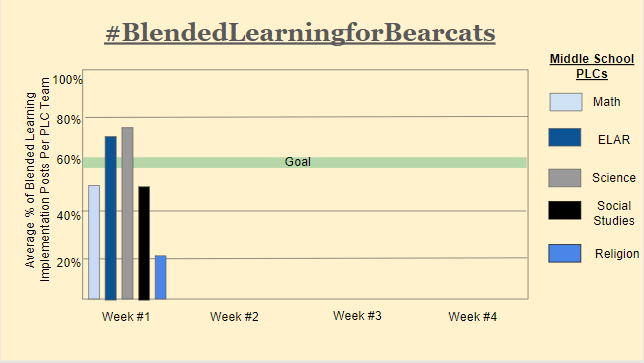
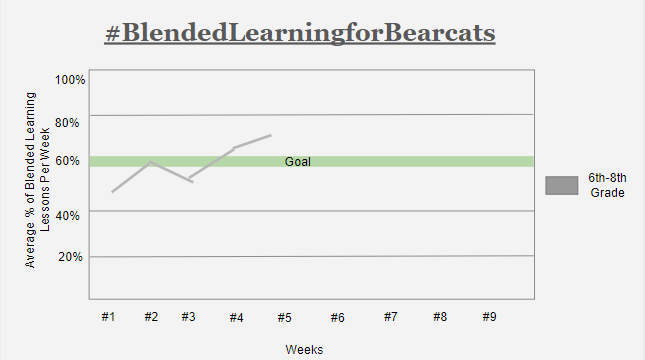
- To incorporate a lead measure for the WIG #1, we will measure if teachers successfully choose to implement 3 strategies (can be software or lesson ideas) per week that support blended learning and then share and document through Twitter using hashtag #blendedlearningforbearcats. Each strategy is done on a different day and so since there are 5 days in a week 3/5 days is 60% of the time.
- The goal is to hold teachers accountable and provide Professional Development and sharing of ideas to teachers through the Twitter platform, rather than require in-person attendance at Professional Development sessions. If we teach teachers how to seek out new ideas for themselves, they will be more successful at finding new ways to implement blended learning rather than having to be taught for an hour in a classroom about each and every way to implement it.
- Create a scoreboard for the players on your team
- The scoreboard for my team will look like this:
- Hold and Schedule WIG sessions/meetings at a minimum of a weekly basis
- Ensuring we are carving out time to meet on a frequent basis to discuss the goal will allow us to do a great job of working toward our WIG. It will hold others accountable when it comes to working toward our goal.
- During the 15-20 minute meeting, we must not succumb to discussing the “whirlwind”. The “whirlwind” may be discussed following the meeting.
- At the WIG meeting, the following should be discussed:
- Account: Report on last week’s commitments.
- Review the Scoreboard: Learn from successes and failures.
- Plan: Clear the path and make new commitments.
Stage 2: Launch
As expected with any launch of an idea or change, there is no guarantee that the launch phase will go over smoothly.
To best support our WIGs in this phase, we must:
- See and acknowledge how a launch phase demands focus and energy. The leader is not exempt from having to focus and devote energy to the goal.
- It is a frequent occurrence for leadership to be so busy with each of their whirlwinds that they forget that we need leaders modeling for us how we should focus and devote time and efforts toward our WIG.
- Trust the 4DX process and remain focused in ensuring its implementation.
- Although our whirlwinds all challenge and push us to get sucked into our day-to-day struggles, we must stay focused and keep our eye on the prize.
- Identify who in your staff are the models, potentials, and resisters
- This portion of the stages reminded me of how with Influencer, we must be aware of who the influencers are within an organization. There are several similarities between how to handle resisters, models, potentials, and influencers. All are very valuable and hold the key to being successful with influencing change, and working toward WIGs. The ideas in both books do an excellent job of complimenting each other and reminding leaders that giving teachers ownership over their goals and identifying who the positive influencers, models, potentials, and resisters are allows for the groundwork to be laid in order to move toward change.
Stage 3: Adoption
The keys to being successful with the adoption of the 4DX are:
- First focus on adhering to what the process requires, and secondly on the results.
- Many people tend to focus on the lag goals first. However, our lead goals must preface and guide our efforts, as well as the measure of our efforts.
- Making a commitment and holding others in the team of teachers accountable through WIG sessions that occur on a weekly basis.
- Weekly track and measure results on a scoreboard that is highly visible to team of teachers.
- A great place for us to put our scoreboard would be in the teacher’s lounge where teachers frequently meet to discuss lesson planning within their PLCs.
- Ensure adjustments are made as needed.
- Utilize additional training and mentoring in order to invest in teachers in the “potentials” category. The potentials are a group of people who hold the potential to be successful with the goal, but struggle at first.
- This is similar to how we handle improving STAAR scores. So often we focus and fixate on our struggling students, or our students who are low. However, while it is important to support all learners, we must focus on our “bubble kids”, or in this case, the “bubble teachers”. They hold the power to swing the outcome of our goal.
- Be straight-forward with resisters about issues and help clear the path for those teachers who resist, if it is needed.
- There will always be resisters when it comes to trying to influence and make any change. Supporting even those who resist is necessary.
Stage 4: Optimization
As teachers always want students to develop ownership over their process of learning, we also want teachers to develop ownership over their WIGs. It is valuable to allow the teams to find ways to optimize their performance, because it frequently motivates and encourage team members to carry out the work that needs to be done. It is the hope that if you are consistently utilizing 4DX, you should be able to expect your team to begin the process of optimization on their own.
To get the most out of this stage:
- Be cognizant and encouraging as you outwardly recognize creative ideas that can be used to move the lead measures, even if some ideas might work better than others.
- Celebrate when there are successes and recognize when there is follow-through.
- So often it feels like in the teaching industry, there are so few celebrations. Often this could be because we spread ourselves too thin while trying to reach our 100 goals. However, in order to support the efforts being made toward accomplishing the WIG, we must celebrate the successes along the way. The scoreboard will hopefully help us identify when to celebrate and when to push harder toward our goals.
- Encourage and support team members in clearing the path for each other and call for celebration when it happens.
- This is another reason why it’s awesome how our lead measure will be measured using Twitter posts, as Twitter is a great place to celebrate successful implementation of blended learning because others can “like”, retweet, and comment posts.
- Recognize when the teachers who are identified as “potentials” begin to perform as the models do.
- This is where we best support our goal and really start to make the push toward the WIG.
Stage 5: Habits
In order to be successful, the 4DX has to become habitual for the members in the group. Stage 5 of implementing the disciplines goes right along with what was learned from Influencer about vital behaviors. Integrating the knowledge gleaned about vital behaviors and the habits created through the disciplines allows for a deep understanding of behaviors needed to be successful in a Wildly Important Goal (WIG). Using the 4DX is habit forming and once it is ingrained in teachers, we can set new goals and stain maintain a high level of execution.
To truly create the habitual component of 4DX, we can:
- Celebrate when the WIG is accomplished.
- Celebrating accomplishments is so valuable. Just like in the classroom, students and teachers alike need to feel like they are winning in order to have motivation to work hard. Thankfully with the scoreboard, teachers can see their progress and eventually when the goal has been reached.
- Immediately move on to the new WIG in order to confirm the 4DX as the system for operations within your team
- Emphasize that the new operating standard will be sustained and superior performance on lead measures
- The disciplines will continue to be able to be applied to so many other WIGs that are going to be implemented.
- Support and help each and every individual team member to become a high performer. This is done by tracking and moving the middle (number of teachers who will potentially be successful).
4DX and the 6 Sources of Influence
Overall, we need to engage in the six sources of influence from Influencer, in order to get everyone on board with the WIG. Particularly during the launch stage, we need to sell the “Why?” to people’s emotions, identify the influencers, and use the six sources to ensure we are successfully able to influence our team and implement change. Appealing to emotions is important, however, we also must find ways to execute and follow through with a plan despite the whirlwind around us. Both strategies lay a great groundwork for successfully implementing change and compliment each other nicely.
References
Grenny, J., Patterson, K., Maxfield, D., McMillan, R., & Switzler, A. (2013). Influencer: The new science of leading change: 2nd ed. New York: McGraw-Hill Education
McChesney, C., Covey, S., & Huling, J. (2012). The 4 disciplines of execution: Achieving your wildly important goals. New York, NY: Free Press.

 Education with Meaning
2 Comments