
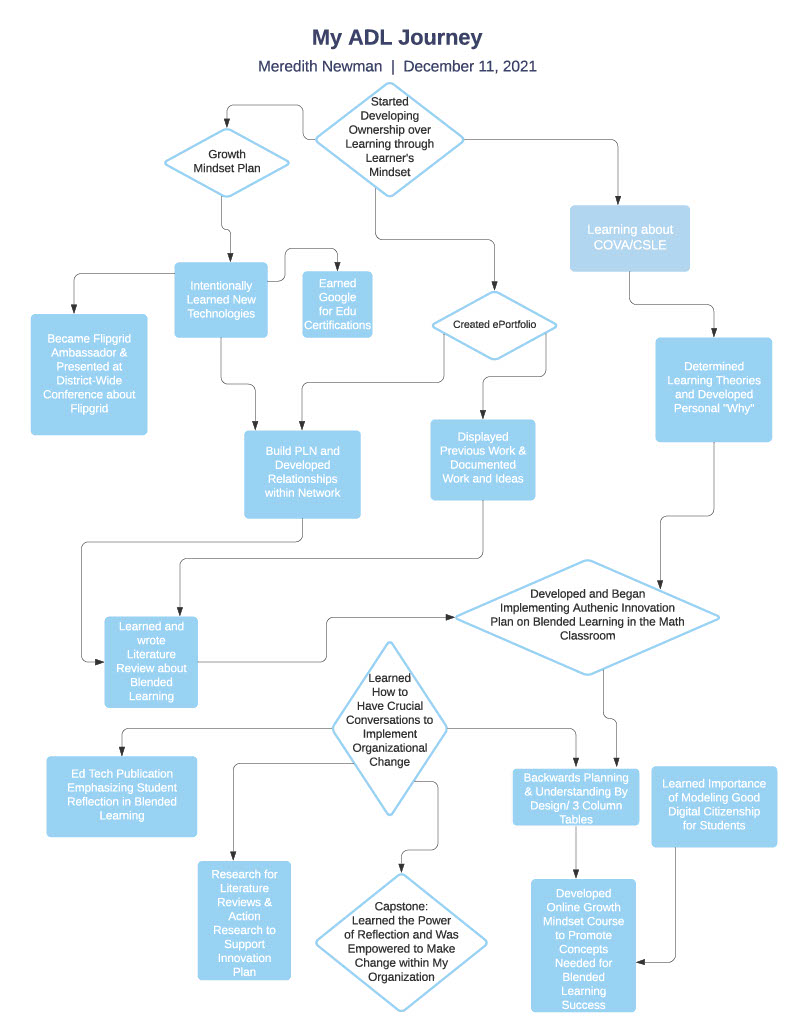
My ADL Experience
- I have taken ownership and agency over the learning process and incorporated choice and voice in designing authentic projects that used technology innovation as a catalyst for change in my organizations.
- I have created an ePortfolio to share my work, reflect on my growth, and develop my voice.
- I have applied leadership theories and practices to become a self-differentiated leader who can address the inevitable resistance to change that will occur when launching innovative digital learning initiatives.
- I have explored technology innovations and embraced them as opportunities rather than challenges and proactively used those changes as catalysts to enhance my institution or district’s learning environments.
- I have identified and incorporated constructivist theories to create and implement significant digital learning environments.
- I am able to assess the instructional impact the implementation of my innovation plans have on creating effective digital learning environments.
- I have examined a variety of digital environments and other digital resources to effectively communicate with others the practical implementation and the pedagogical value for educational use.
- I have an article that I am still editing for publication regarding reflection in the mathematics classroom.
- I have applied constructivist learning theories and instructional design principles in the development and delivery of an online course utilizing significant learning environments through selected course management tools.
- I have synthesized my knowledge, skills, beliefs, and values gained through their digital learning and leadership experiences and present a comprehensive plan on how they developed into digital learners and leaders that can identify and promote innovation, create significant digital learning environments, and lead organizational change.

About Me
As an educator, I always want my students to be constantly making connections to their prior knowledge. I do not want students to feel like learning math in my classroom requires memorization. I hope students are able to learn through real-world, engaging problem-based lessons in my classroom. I want my students to feel that learning is “making sense or abstracting meaning” from the world (Smith, 1999-2020). I also want for my students to view learning “as interpreting and understanding reality in a different way” (Smith, 1999-2020).
It is crucial for students to have access to problem-based lessons so students can make connections to real world problems. I see frequently in the mathematics classroom that often a student may know the basic operations they must complete to solve the problem, but they may not yet know how to connect their knowledge to what we are learning until they see the need for this additional learning or reorganization of prior learning for a real-world purpose.
We, as teachers, need to support students in learning how to love learning. When a task gets complicated, the carrot-and-stick strategy does not truly motivate students. If any of my students think that learning math is all about memorizing algorithms, they haven’t understood what math really is meant to be. Without experiencing the joy in understanding math for themselves, they in fact will likely not understand how as we learn math, we are making sense of the world through numbers. Math is supposed to make sense. Learning is supposed to make sense.
The learning theory I most identify with is cognitive constructivism. I work to create and “build settings in which conversations and participation in particular learning can occur” (Smith, 1999-2020). Several Constructivists are Bruner, Dewey, Lave and Wenger, and Vygotsky. I especially like how the constructivist theory allows for reflective practices, where students can share, connect, discuss and learn about others’ experiences with math. There is value in learning how to listen and how to learn from listening to other classmates. I do not want to be the only person students learn from in a school. I believe one of the greatest things students can learn is how to learn from their others’ reflections as well as their own.
Main Interest
In 2014, I began my undergraduate degree at Baylor University in Psychology. Once I discussed career opportunities with others, I decided school counseling would be the best route for me to follow. Along the way, I met an incredible professor who convinced me to begin my career in education by majoring in education. I somehow was encouraged to teach math, which was my least favorite subject while growing up. I spent the past two years teaching 5th grade math. Now, I am loving spending the time helping kiddos learn, explore, and engage their voice in the world around them in the 6th and 7th grade math classroom. God works in crazy ways!
Impressively, the trends in education have been pushing to provide students with real-world, applicable tasks that lead to authentic learning. Although this is valuable, it is almost as if we have forgotten that our intrinsic motivation and drive can only be amplified by having a “why”. I am constantly searching for ways to help students discover an answer to “Why?” is there a need for math and what is their own “why”.
My current “Why” is that I have a deep desire that students learn the value of the positive feelings we experience during learning and growing through blended learning, rather than learning that there is value in memorizing, finding answers, or regurgitating knowledge. I want students to believe that they belong as mathematicians. I want that so badly for them. The further we get into this pandemic, the more I see kids losing their connection to learning.
CSLE+COVA & Learner’s Mindset

Many teachers would argue that this year in education has entirely relied upon using technology to successfully and safely teach students. However, we need to carefully curate and choose which resources to use so there is a learning-based approach, rather than teaching-based approach. The teacher cannot be the focus of our classrooms. With a learning-based approach, students are being given the tools they need to learn how to not only learn, but how to love learning. Douglas Thomas and John Seely Brown write how:
“learning should be viewed in terms of an environment- combined with the rich resources provided by the digital information network- where the context in which learning happens, the boundaries that define it and the students, teachers, and information within it all coexist and shape each other in mutually reinforcing ways” (2011, p.35).
One of the biggest challenges of implementing engaging, fun and exciting lessons within the blended-learning context is how it requires teachers to have access to be very creative or to find the right resources. As a math teacher, Robert Kaplinsky and his mathematics problem-based lesson search engine has proved to be a great resource. As the innovation plan is adopted and blended learning is spread throughout the middle school, providing teachers with resources will be a necessity.
“Students learn best when they are able to follow their passion and operate within the constraints of a bounded environment” (Thomas & Brown, 2011, p. 79). The inquiry process pushes learners to ask “‘What are the things that we don’t know, and what questions can we ask about them?’” (Thomas & Brown, 2011, p. 82). In the math classroom, so much learning happens when students ask other students questions while collaborating.
Readjusting the perspective of an organization to emphasize play and imagination will at first appear childish to some people, however the learning that will occur in the classrooms which promote imagination and play will speak for itself. If this is done correctly within an organization, cheating will become less prevalent and the passion for learning will be evident. After all, “where imaginations play, learning happens” (Thomas & Brown, 2011, p. 118).
Projects (Innovation plan)
At the start of the program, if you had asked “Are you an innovator?” I likely would’ve told you no. Thankfully through the ADL program, I have been given the opportunity to explore that question and dive in. Now when I answer the question “How are you an innovator?”, I can go into great detail and share all of the new and exciting ideas I have tried out in the classroom.
Below is a video describing what I am currently doing as an innovator.
Through the ADL program, I have discovered just how valuable blended learning is to learners. I hope that through my efforts, my students are able to grow as learners. Read here about what all my innovation plan has entailed.
My learning community

When I first set foot into the classroom as a first year teacher, I felt thoroughly supported by the teaching community thanks to my involvement in learning networks. As soon as I had announced to my Facebook friends that I was teaching, I was inundated with support. I received classroom supplies and teaching materials from my student teaching mentor teachers, professors, community members, and previous childhood teachers.
Twitter and my PLC (professional learning community) at school are probably the PLNs I contribute to most. By continuing my professional development through the three new communities, I hope to be able to eventually contribute and collaborate more. I hope to do this through Twitter, presentations associated with various learning communities, and this website.
I have been involved with NCTM (National Council for the Teachers of Mathematics), CTCTM (Central Texas Council for Teachers of Mathematics) , TCTM (Texas Council for Teachers of Mathematics), and ATPE (Association of Texas Professional Educators). I would like to become more involved in: Google for Educators, Shake Up Learning, and TCEA (Texas Computer Education Association). My new job as the Digital Skills/ STEM teacher has allowed me to learn more about the ISTE standards and because of that, I am now an ISTE (International Society for Teachers in Education) member. Although I now am a 6th and 7th grade math teacher, having a knowledge of the ISTE standards and resources help me.
Facebook Groups
I have had a Facebook page since I was a freshman in high school and I recently have learned how valuable it is to have a PLN to troubleshoot, share and learn new ideas for teaching. The school I started working at in August 2020 just recently adopted G Suite for Education- Enterprise Edition, so being able to ask questions, troubleshoot and learn more in PLNs has been so helpful.
G Suite Teachers Group
Flipgrid Student Voice Ambassador Group
Nearpod Educators
Google for Educators
I would like to work towards the various Google Educator Certifications because it would be very useful knowledge to have. My students have Chromebooks and I would love to know more about how to best utilize them. I currently use GoogleSlides for easy presentations of lessons that include a lot of graphics or for when I have a sub (I just put it on a USB Flashdrive and plug it into the TV). I also have organized all of my teaching activities into GoogleDrive.
International Society for Technology in Education
I am now an ISTE member! The year of 2020 has proven to be a year full of challenges and perseverance. However, leaning into good quality resources makes life as a teacher much more do-able. ISTE hosts excellent technology conferences and provides educators with useful knowledge for successfully implementing technology.
Texas Computer Education Association
I hope to become a member at TCEA as I learn more and develop as an educator in the DLL program. I will work to attend a TCEA conference in the future. I know I will learn more about all that TCEA has to offer as I develop in the DLL program at Lamar University.
Central Texas Council for Teachers of Mathematics
I have attended and presented at local CTCTM meetings and had great take-aways. It is a great resource for Central Texas teachers. CTCTM hosts a spring and fall conference. Both have good raffle prizes, excellent sessions, and there always is an impressive keynote speaker. Previous keynote speakers include Cathey Seeley and Cathy Yenka.
National Council for Teachers of Mathematics
I am going to attend NCTM’s CAMT in July of 2019. NCTM published many great books, including Principals to Actions, Taking Action: Implementing Effective Mathematics Teaching Practices in Grades 6-8, and Mathematics Formative Assessment 75 Practical Strategies for Linking Assessment, Instruction, and Learning. NCTM also publishes informative journals which target math concepts for specific grade ranges. They are filled with useful, fun activities as well as research.
Viktor Frankl Institute of Logotherapy
The Institute does an excellent job of putting on an international conference and fostering relationships between professionals involved in all industries. I delivered a presentation over my action research from my senior year at Baylor. I researched meaning and purpose in the math classroom. The conference allowed me to develop relationships with great people and receive insightful feedback. I look forward to working towards publishing my research.
Interested in Keeping Up with My Future Discoveries?
Follow me on Twitter @MrsNewmanTweets
Click here to see my resume.
Resources
Bates, T. (2019, March 17). Learning Theories and Online Learning. Online Learning and Distance Education Resources. https://www. tonybates.ca/2014/07/29/learning-theories-and-online-learning/.
Culatta, R. (2018, November 30). Constructivist Theory (Jerome Bruner). InstructionalDesign.org. http://www.instructionaldesign.org/theories/ constructivist/.
Constructivist Theory (Jerome Bruner). InstructionalDesign.org. (2018, November 30). http://www.instructionaldesign.org/theories/ constructivist/.
Frankl, V. E. (1984). Man’s search for meaning: An introduction to logotherapy. New York: Simon & Schuster.
Gerstein, J. (2019, March 11). Authentic Learning Experiences. User Generated Education.https://usergeneratededucation.wordpress.com/2019/01/20/authentic-learning-experiences/.
Harapnuik, D. (2016, March 11). harapnuik.org. http://www.harapnuik.org/?p=6344.
Kaplinsky, R. (2020, October 20). Problem-Based Lesson Search Engine. Robert Kaplinsky. https://robertkaplinsky.com/prbl-search-engine/.
Learning Theory Project Team of HKU. (2018). History of Learning Theories. https://kb.edu.hku.hk/learning_theory_history/.
Smith, M. K. (1999-2020). ‘Learning theory’, The encyclopedia of pedagogy and informal education. https://infed.org/mobi/learning-theory-models-product-and-process/. Retrieved: March 11, 2021.
Tan, S. C., & Hung, D. (2003). Beyond information pumping: Creating a constructivist e-learning environment. Educational Technology, 42(5), 48-54.
Thomas, D., & Brown, J. S. (2011). A new culture of learning: cultivating the imagination for a world of constant change.

 Education with Meaning